IBM SPSS Conjoint

Easily Discover What People Value
- Overview
- Features and Benefits
IBM® SPSS® Conjoint gives you a realistic way to measure how individual product attributes affect people’s preferences.
When you use both conjoint analysis and competitive product market research for your new products, you are less likely to overlook product dimensions that are important to your customers or constituents, and more likely to successfully meet their needs.
With IBM SPSS Conjoint, you can easily measure the tradeoff effect of each product attribute in the context of a set of product attributes – as consumers do when making purchasing decisions.
For example, you can answer critical product market research questions:
- What product attributes do my customers care about?
- What are the most preferred attribute levels?
- How can I most effectively perform pricing and brand equity studies?
You can answer all of your questions before you spend valuable resources trying to bring products or services to market. Use IBM SPSS Conjoint to focus your efforts on the service or product development that has the best chance of succeeding.
IBM SPSS Conjoint gives you all the tools you need for developing product and service attribute ratings. You can use its three procedures to:
- Generate designs easily – use Orthoplan, the design generator, to produce an orthogonal array of alternative potential products or services that combine different product/service features at specified levels
- Print "cards" to elicit respondents' preferences – use Plancards to quickly generate cards that respondents can sort to rank alternative products
- Get informative results – analyze your data using Conjoint, a procedure that's a specially tailored version of regression. Find out which product/service attributes are important and at which levels they are most preferred. You can also perform simulations that tell you the market share of preference for alternative products.

Conduct intelligent planning
Expand the capabilities of IBM SPSS Statistics Base with IBM SPSS Conjoint. Make better decisions about your data and gain knowledge in the planning stage that you can carry throughout the analytical process.
Save time and money by generating a set of conjoint experimental trials that are a fraction of all possible combinations and attribute levels. You'll quickly learn how your respondents rank their preferences when you create and print cards they can sort. And, with the results from the Conjoint procedure, you'll learn how your respondents rank product attributes. Here are more details on each procedure:
- Orthoplan enables you to generate orthogonal main effects fractional factorial designs and display results in pivot tables.
- Plancards enables you to produce printed cards for a conjoint experiment.
- Conjoint enables you to perform an ordinary least-squares analysis of preference or rating, working with a plan file generated through Plancards or with one inputted from a data list. Various graphing and printing options are available.
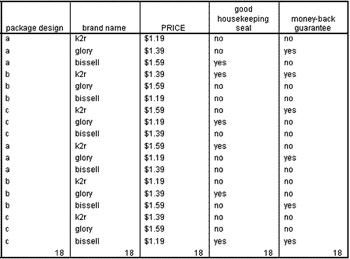
Figure 1: The Orhtoplan procedure generates a fraction of all possible alternatives. In this example, it has generated an 18-run orthogonal array instead of all 108 possible combinations.
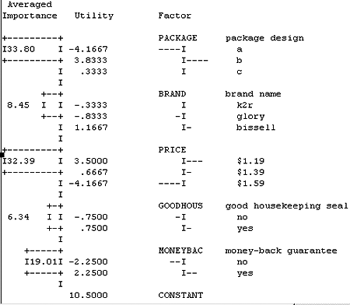
Figure 2: Easily identify the attributes a group of consumers prefers.